

A doctor for smart homes and buildings

You know what isn't working. Your building knows why.Care understands you and your building.

How it works
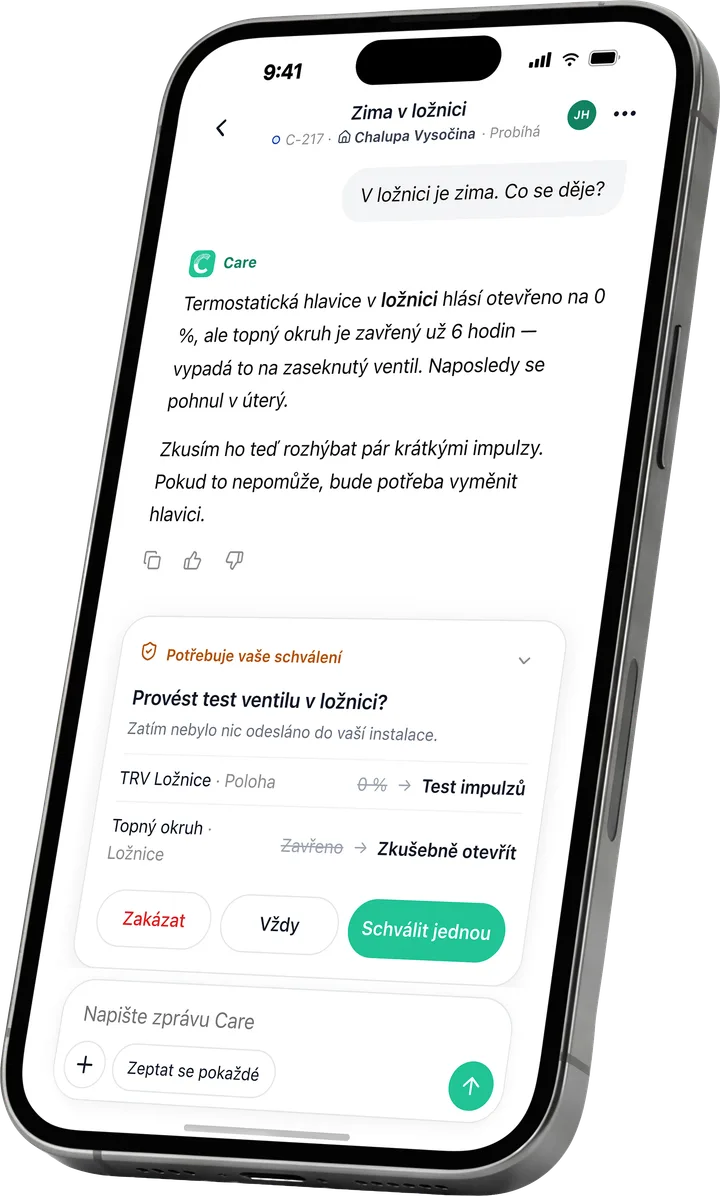
Care answers the question of why the bedroom is cold

Imagine a world where…

…solving a problem starts with a question.

How Care works

When you know the whole building, you know where to look

Care combines experience from past service cases with your building's program, live data and diagnostics. When it finds the cause, it can suggest the next step and verify the change safely.

01

Knowledge Engine

Care links device documentation with a database of previously solved faults and proven service procedures. It recognises when a known problem pattern repeats in your building.

Use case 1 / 3

The entrance keypad doesn't respond.

Care finds that the intercom whose bus the keypad is connected to is offline too. It finds the same combination of symptoms in its database and recommends restarting the intercom, then checking both devices.

02

Config Timeline

Care keeps program versions and a timeline of changes and events. It can compare the last working state with the current one and trace what preceded the fault.

Use case 1 / 3

A button stopped switching on the LED strip.

Comparing versions shows that after an older configuration was uploaded, the link between the physical button and its lighting circuit disappeared. Care pinpoints exactly the missing link to restore.

03

Behavior Graph

A semantic model connects rooms, devices, rules and expected behaviour. With it, Care understands the whole situation, not just the state of a single device.

Use case 1 / 3

The garage light comes on and never goes off.

Care follows the path from the motion sensor through the lighting scene to switch-off and finds the missing rule for the no-motion period. It suggests adding that condition.

04

Live Telemetry

Care reads live values and events from the installation and maps them to specific parts of the program. It sees which condition is in charge right now.

Use case 1 / 3

The room is cold even though the heating is on.

Care sees the target temperature and an active “window open” signal that blocks the heating. It recommends checking the window and its contact before anyone touches the controls.

05

Debug Trace

Care reads system logs and diagnostic records that everyday building controls never show. It can tell a symptom of a fault from its likely cause.

Use case 1 / 3

A device in the bathroom keeps dropping out.

In the log, Care finds increasingly frequent unexpected restarts before the full outage. It identifies the exact device and branch where the technician should measure the power and check the connections.

06

Safe Replay

Before deploying a change, Care checks its impact and, depending on the kind of change, tests it against historical events or in simulation. It asks for the required approval and watches the result after deployment.

Use case 1 / 3

The blinds stay up after strong wind.

Care suggests a rule for returning once the wind protection ends and tests it against previous windy days. After a technician approves, it deploys the change and checks how it behaves.

You wait days for a technician.
Care helps right away.

Tell Care what isn't working. It goes through your building's data, configuration and history, finds the cause and often helps solve the problem without a technician visit.

With Care
You ask Care
Care finds the cause
✓ Often solved without a visit
Without Care
You report the fault
You wait for a technician's slot
The technician looks for the cause
Repair

A technician steps in when needed.

If the fault needs someone on site, they arrive with a specific diagnosis already. They never start looking from scratch.

AI guesses. Care knows.

Claude, ChatGPT, Gemini or Grok can describe very convincingly what might be wrong. Without knowing your installation, though, they can't see what actually happened in it. Care bases its answers on your specific devices, technicians' proven experience, live data, diagnostics and the building's program. And when the evidence isn't enough, it tells you what it still needs to check.

  1. It knows your building

    It knows which devices you have, where they are and how they relate. It isn't looking for generic “smart home” advice, but for the cause of the problem in your installation.

  2. It knows problems technicians have already solved

    It compares symptoms with device documentation, proven procedures and past service cases. It knows which explanation is worth checking.

  3. It sees what really happened

    It reads current states, event history and debug records, so it can tell a plausible theory from what the device actually did.

  4. It understands why it happened

    It reads the building's program, the links between devices and configuration changes. It can find the rule that caused the behaviour, or the step that is missing from it.

  5. It tries nothing without your consent

    Care can prepare a proposal and check its impact. Before a test, a restart or a change in the real installation, it asks for approval. Afterwards it verifies whether it helped.

Want Care for your smart building?

Leave us your details. We'll get in touch, find out what installation you have and show you how to connect Care to it. It works with existing installations too.

Once you send it, we'll get back to you and agree on the next steps.